Trash Containers, Trash Talk, Trash Love: On horror's sneaky formalist tendencies and the genius of Daniel Kraus
My favorite horror is exuberant, generous in its embrace of tropes and setpieces, and Daniel Kraus’s Pulitzer-prize-winning Angel Down is a perfect example: yes, it’s a WWI trench-warfare piece, and yes, there’s an angel that’s been shot down, and yes, there’s gore, and heck yes, it’s a whole-ass novel that is also a single sentence. Horror gets a bad rap for lots of reasons, one of which being bad taste, and one way bad taste gets manifested—or signaled or whatever—is through its rejection of restraint. (Lots of color in a house? Trashy. Dressing your baby in sage and taupe? Classy).
And Angel Down is saying yes to a lot. And that’s because he’s coming from a tradition where the minimum, most of the time, is a lot.
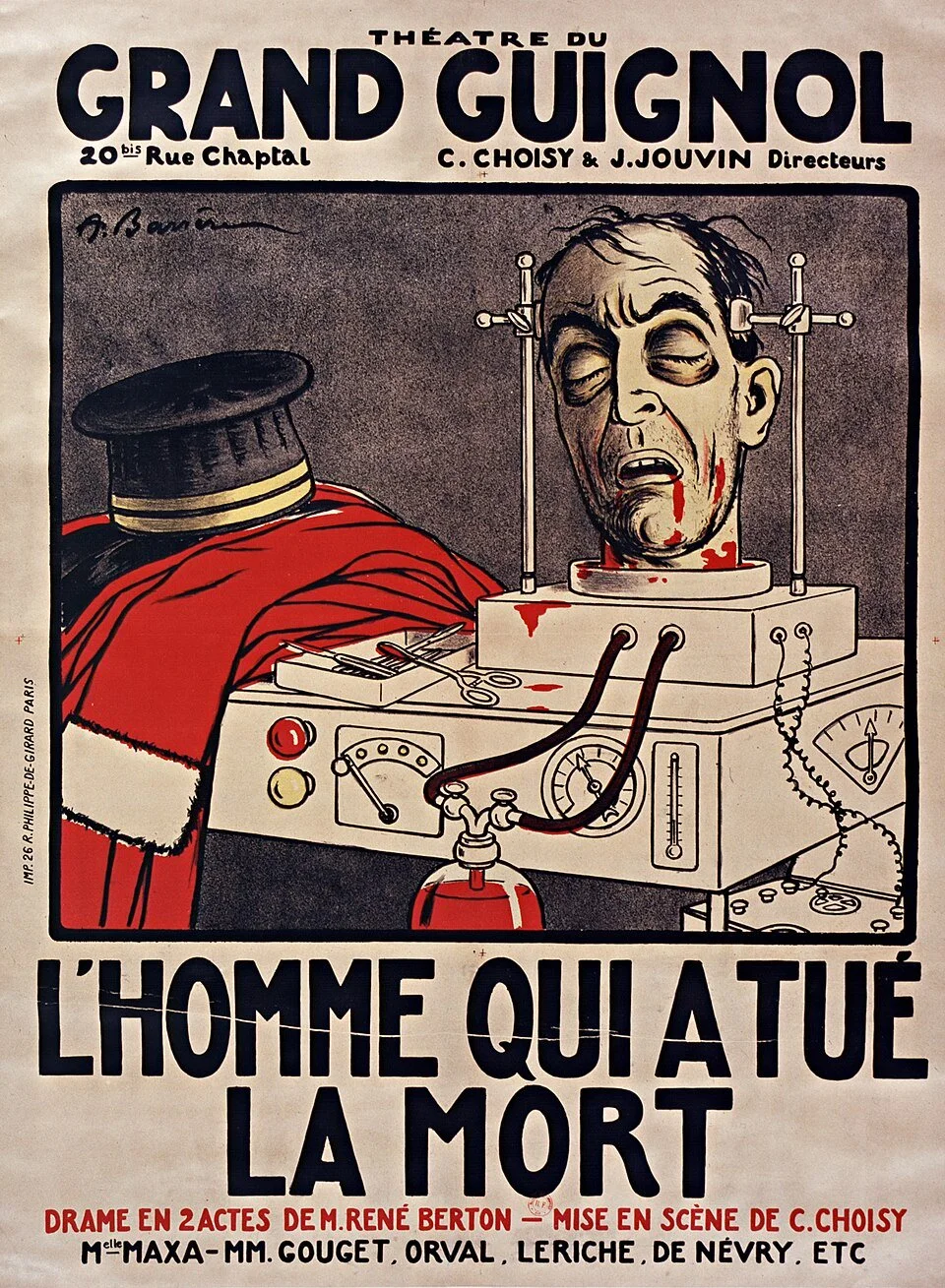
Like, when most genres politely look away from a particularly indecorous event happening to a body, or a body part, horror will linger—linger for like a page, or a sentence, or a whole chapter. Or a whole novel. (Or, in the case of the illustration above: a whole play where the point is how gory can we get.)
I’m writing this partly as this weird extension of some thoughts I had on kidlit and how glorious and chaotic young readers can be, and how the formation of taste can also serve as an unfortunate norming. We want things to be good. We want to be seen reading good books. We certainly don’t want to be caught reading trash.
But I love trash.
I love disreputable novels, flawed novels, wonky novels.
I adore lots of stuff that I wouldn’t exactly care to defend, and so it’s both incredibly awesome and exciting to see Kraus win the Pulitzer, mostly because it’s such a terrific example of what genre—and horror in particular—can do, but also because much as I love that horror is scuzzy and disreputable and impolite, it’s also nice to see its genius recognized by a wide audience, and maybe that audience will read more of it, and see the incredible skill and craft and restraint that goes into a good scare.
Sure, horror is a genre that loves too-muchness, but it’s also a narrative form that makes the most of self-imposed formal constraints—and because those constraints are always in the service of freaking out the reader, they tend to get lost in the shuffle. Kraus’s last three books are perfect examples: Angel Down’s historical and supernatural elements are bounded by the constraint of that single sentence; Whalefall, where a man is swallowed by a whale, is bounded by the amount of oxygen remaining in the tank; even the new one, a memoir titled Partially Devoured, is bounded by a frame-by-frame analysis of George Romero’s Night of the Living Dead, so that while the book goes places, it does so while navigating a pretty tight container.
(And the expectations of horror are, themselves, a kind of formal and miraculous formal constraint, because if you’re doing a haunted-house story, you better deliver on some tropes, and ditto for folk-horror or splatterpunk or body horror or whatever.)
I could mention, too, how these constraints are very much a defining feature of horror’s material circumstances as well—both as commercial products but also as as a whole, particularly because horror movies are often low-budget affairs, and so their limits are already pre-set: there’s only so many sets you can use, only so many actors you can cast, good luck. Night of the Living Dead is itself a perfect example of the kinds of genius that constraints bring forth.
I could go on! I won’t! I will say that I’m glad that other folk will get to experience what a truly freaking special experience it is to read in genre—and to maybe realize that even if writing horror is not your jam, there’s a lot that you can learn from it (and from sci-fi, and from the Weird, and from fantasy and crime and Romantasy and romance and from everywhere). I adore literary fiction, by the way, and I deeply believe that it deserves my adoration and that of anyone who loves to read, period—but I’m often amused by how resistant some literary writers are to the genuine, and startling, formal turns you find in horror. I remember this one teacher who absolutely hated Stephen King but assigned On Writing to her class because it was the best book on craft she could find.
I’ve seen this suspicion persist, and I imagine it will persist despite Kraus’s victory—which is truly a victory both for him and for all of us who read and write and champion horror—but there’s a part of me that’s cool with that, and maybe even more than cool: I’m kind of happy with it. I’m down with horror being, despite all the evidence, a little suspect, a little trashy, because then we’re all free to do the awesome things we can do, including figuring out what constraints we want to introduce into our next bloody thing.