Someone’s Dead
I’m deep into a re-read of Robertson Davies’s extraordinary Fifth Business (1970), which in its own sly way is a bit of a detective story: someone’s dead, someone’s been killed, and the dead person in question is the delightfully (self-)named Boy Staunton, and coiled around the death there’s this slow, bubbling web of memory and oddball characters, at the edges, a meditation on myth and magic and Canadian life. I’m making this short, punchy novel sound way heavier than it is. It’s just really fun, and I’m glad to be deep in Davies—and surprised to see how sturdy the mystery genre is, how capacious—like, capacious enough for me to say that Davies wrote a mystery even if Davies himself may not agree.
But what can he say? Davies, like Boy Staunton, is no longer with us. So Fifth Business is a detective novel.
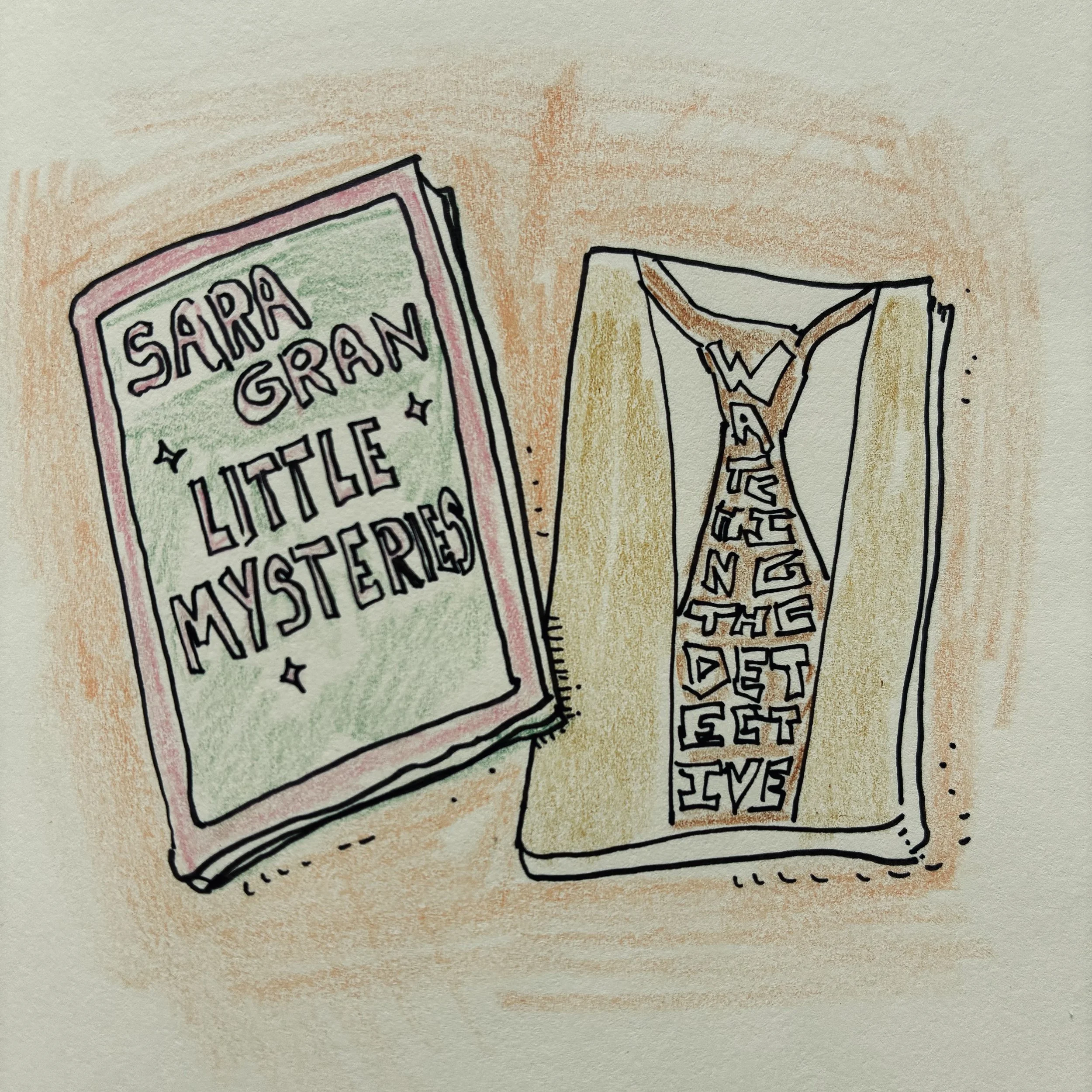
I’ve been deep into the comforts of detective fiction and noir and everything in-between for the last two or three years (alongside all kinds of other stuff, of course), and it struck me that my all-time favorite new books of 2025 were not just mystery and detective-adjacent—they were also independently published: Sara Gran’s Little Mysteries and Deborah Shapiro’s Watching the Detective.
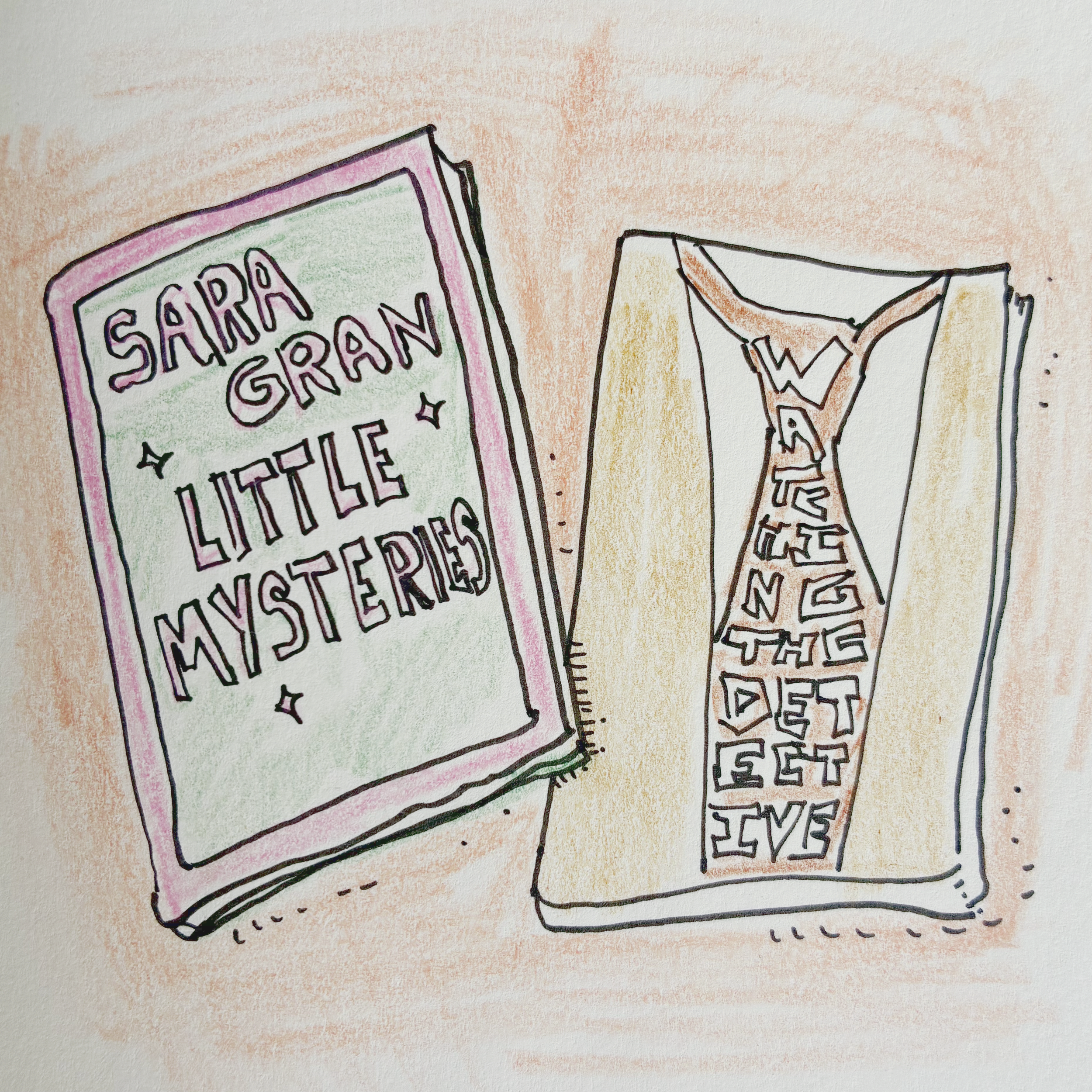
I drew this! Love these covers.
And I don’t mean, like, published by an indie press, even if they weren’t exactly self-published. They were published by authors running their own presses. Sara Gran runs Dreamland Books. Deborah Shapiro runs B-Side Editions. They do beautiful stuff. You should check them out.
Shapiro’s Watching the Detective is this gorgeous memoir/cultural-exploration that coils around the detective show Columbo (1) and excavates all kinds of fascinating cultural history around it: the clothes, the cars, the particular paint-jobs on the cars, the cultural and material conditions around it, fathers and daughters. All of that plus startling, offhand insights into Peter Falk, John Cassavetes, set design, and the grimy particularities and peculiarities of the 1970s. I could go on. I won’t. Buy the book, OK?
The same goes for Gran’s Little Mysteries: nine beautifully written, off-kilter mysteries—one a paragraph long, two of them long, hilarious, dark riffs on Carolyn Keene(2)’s house-style for the Nancy Drew series. If you’re a fan of Gran’s Claire deWitt(3), she’s in there. She’s still the world’s greatest detective. She’s still deeply messed up.
What distinguishes these two extraordinary books, for me, is how gorgeously they braid readerly expectations (“I love Columbo! I want to know more about Columbo” & “I love mysteries! I want to see someone figure out who killed X!”) with some bonkers stylistic high-jinks (Gran’s Nancy Drew parodies and general celebration of bad behavior! Shapiro’s unlikely personal and cultural linkages!). But also? There’s a universe where both of these writers could have written and published way more boring versions of these books through a traditional press, and I’m so glad they didn’t. I don’t want to make a grand statement about the Publishing Industry Today, but at the very least I’ll say that it’s interesting, for me, that even in the indiest of indie situation we’re still navigating one of Dan Sinykin’s insights in Big Fiction—that literary forms continue to embrace and mess with genre elements in really cool ways, for all sorts of reasons that tangle market expectations with literary sensibilities. And it does strike me as odd that these are the books that lingered and haunted me from last year. It wasn’t the big press ones. It was these two delightful weirdos.
And there’s weight and substance to the weirdos. There always is.
Martin Scorcese had this great insight on Westerns in the 1950s, that as long as you had a couple of shootouts you could sneak whatever formal and cultural stuff you wanted into your movie, and so you had Budd Boetticher’s The Tall T as a commentary on McCarthyism. But also, Boetticher’s films were as offbeat and stylized as Gran and Shapiro’s novels.
***
I’m also reading Josephine Tey’s The Daughter of Time (1951), where a detective stuck in a hospital bed solves a major Richard III murder mystery, and Seichō Matsumoto’s Tokyo Express (1958), a mystery so spare and brilliant plotted and carefully calculated, and written so cleanly that I’m kind of blown away by how this particular genre is the best way to understand the strictures and expectations of narrative. But also how we’re willing to pretty much go anywhere as long as we have an author who understands what we’re coming in for, and why, and how to mess with our expectations in ways that feel productive and smart and fresh.
We just need to make sure someone’s dead and then the whole thing is alive.
***
(1) The closest I’ve seen someone come to this is Ander Monson’s Predator, where Monson watches the movie Predator 146 times (more since then, too) and excavates all sorts of amazing stuff on masculinity, the 1980s, school shootings and gun control, video games and the portrayal of violence. Check it out: It’s so good!
(2) Yes! I know Carolyn Keene is not a real person--just the pseudonym for all the writers that collectively wrote the Nancy Drew mysteries. She’s still kind of real in my heart, as I imagine she must be for anyone who read the books when they were kids.
(3) I adore Claire deWitt! But my entry point into Sara Gran was her short horror novel Come Closer, which is not just genuinely freaking scary but also, in the most messed up way, deadpan funny and makes the case for why being possessed by a demon may actually be kind of fun and liberating.